



SEND TO A FRIEND
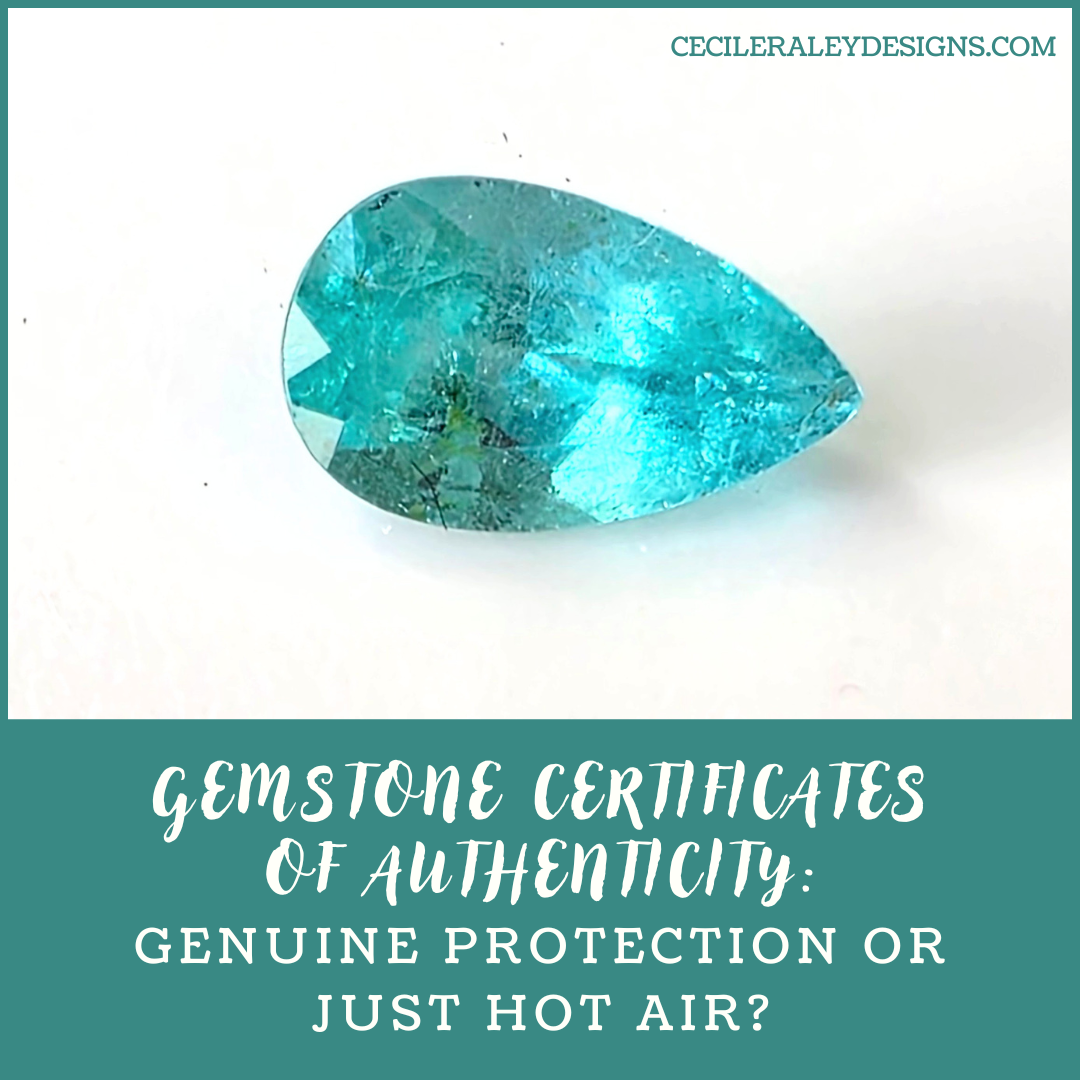
Gemstone Certificates of Authenticity: Genuine Protection or Just Hot Air?
Yvonne Raley – Nov 19, 2026On Etsy, I get asked for a “certificate of authenticity” for my gemstones on a weekly basis. And if I respond by saying that it is unethical for me to supply it, reactions are quite mixed. Some clients are understanding and request either a laboratory certificate, or an itemized invoice for insurance purposes instead. Others get upset and demanding, saying that they are entitled to proof that my gems are natural and earth mined. In other words, they demand that I prove to them that what I am selling them is what I say it is.
But let’s start at the beginning: what exactly is a certificate of authenticity anyway?
To the best of my understanding, people believe that a certificate of authenticity is a laminated card that has information about the gemstone (carat weight and size), and it says that this gemstone is an authentic sapphire, emerald, etc. In other words, that it isn’t a fake.
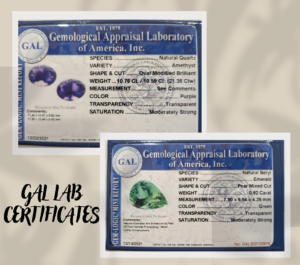
A certificate of authenticity is not, however, an independent laboratory report. No lab report uses the language “authentic” or anything similar, like “natural,” “earth mined.” And more importantly, a lab report isn’t free, so it cannot be included for free with a small gemstone. The cheapest laboratory report I can obtain is a card from Gemological Appraisal Labs, GAL, on 5th Avenue in Manhattan. They are a small but reputable laboratory that can ID the gem, together with a photo and measurements as well as carat weight on a small card. The little ID card costs $30, so it isn’t a feasible thing to obtain for gems that cost less than maybe $200-300. So it would not be available for most gemstone melees – gems under 3mm. Secondly, gems under half a carat are harder to test and many laboratories do not have the attachments for the Xray machines to even test gems that size. AGL for instance does not take any gem under .5 carats.
When I get requests for a “certificate of authenticity,” as opposed to a request for an “independent laboratory report” I infer that the client is asking for something that I produce myself with a high quality printer and a laminator.
I presume you can see why that would be unethical. First, it does not add anything to an itemized invoice other than see-through plastic. Secondly, it does not state anything additional to what an invoice should say.
However, it does create the impression, via the official looking laminate, that I have now provided the client with something in addition to a receipt, something valuable and authoritative. Something that can be used for resale, or something that provides verification that the seller is legitimate. All that, simply because the card is laminated as opposed to being on a piece of printed paper with my logo on it.
It’s exactly like a doctor’s coat, or scrubs. Wearing white does not make you an M.D., and scrubs can be bought by anyone on Amazon.
As members of the American Gem Trade Association, however, these are precisely the impressions that we are trying to avoid: we do not want to blatantly self-reference the fact that we sell natural gemstones. In other words, we do not want to create the false impression that we are offering an additional means to legitimize the gem other than what an invoice already states. That is why it is not our policy to provide such a thing.
Furthermore, I would suggest avoiding any seller who offers such a certificate. With one exception: if a company is the actual miner and processor of the gems, they can verify this for you and they provide that in the form of a card. For instance, Greenland Ruby, a company that owns the only ruby mine in Greenland, and that mines, cuts and distributes their own gems only, should be able to certify that for you in some way. Also, if a business is registered in a country with strict and enforceable consumer protection laws, such as Canada, Australia, the EU and the US, the laws themselves give you additional reassurance that you received what you bought and paid for.
If you prefer an independent laboratory certificate and the gem seller you are doing business with does not provide that for a gemstone, there are still certificates that you can request. One option is a small Gem ID, such as an AGL Prestige report ($80), or a GAL gem ID ($30), or something similar.
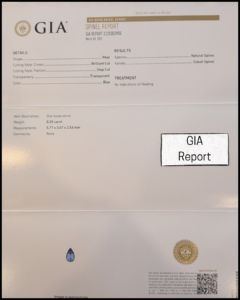
You can also ask for a GIA report for $75 and up (that is the price for under 2 carats). The latter will give you provenance (origin) and treatment as well. And a full AGL report will do that also but it is more elaborate and more expensive, starting at $260.
However, you need to expect to pay the bill for these reports for smaller gemstones, as they are not usually included in the purchase price. US sellers do not assume that they must provide a report unless the gem is of higher value. An invoice should provide the same information, after all. And any AGTA members are required to disclose this information, especially treatment. Most reputable jewelers and gem sellers do the same.
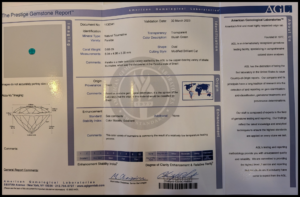
When it comes to independent laboratories, you should check into the lab to find out its reputation before you assume that it is unbiased and reliable; many smaller labs or labs in less affluent countries do not have the latest equipment, or they lack an origin library to compare the X-rays of the gem you are purchasing to the X-rays of other gems from the same origin to verify the accuracy of the seller’s claim. Results can easily be different from what a more sophisticated laboratory would state. For example, many sapphires labeled “padparadscha” by a lab in Sri Lanka may not be labeled such by AGL in the U.S. In fact, this is a typical example, and I have seen this happen often.
Also, some smaller laboratories in other countries are outright corrupt. They may not outright lie, but they may certify without proper testing and inflate the value of a gem by adding “pigeon blood” or “padparadscha” or “royal blue” to the label of a sapphire. These are terms of distinction that are rarely applied in the US, but rather commonly applied by some smaller overseas labs. In other words, these labs are there to help the seller, not the buyer – perhaps because it is the seller who pays them.
Another pitfall for online purchases that state that they have a lab report, is that not all the certificates are legitimate. For instance, look at this listing on eBay for a Jeremejevite. This gemstone is sold from India. It is 7.1 carats and flawless. Which means, in short, that it doesn’t exist. And if it did exist, it would be museum quality and not sell for $109. But more seriously, if you click on the details, it tells you that the Jeremejevite is certified by AGL. But there is no photo of the report included. Reasonably so. AGL charges $80-450 for a report for a stone that size. So it is impossible that a gem for $109 is certified by AGL.
Assuming I wanted to still buy that piece of Jeremejevite, I would ask for the report number and an image, and I would look up the report. Most gem labs have all their reports listed online by number, and if they do not, you can send them an email. And for a very expensive gem, you can even ask the laboratory to make sure that the stone you are buying is the one referenced in the report. You have to send the gem to the lab for that or ask the seller to send it in but then ask for the results to be sent to you. I believe that this service is free.
All gem laboratories have price lists online, as well as detailed information on what each type of report includes, then you can decide what type of report you would like.
Here are the links to pricelists for AGL and GIA. GAL does not have an online price list but but, as mentioned above, a simple gem ID card costs $30.
If you only want to buy a gem with a report, but the gem you are eyeing does not have one, you can negotiate with a seller that you will buy a gem “subject to certification” meaning that you will pay for the report only if it says what the seller claims, otherwise the seller pays for it, and the seller also refunds the purchase price. In this case, you buy the gem, the seller then mails it to the lab, you get the results and then pay the bill. This is quite a safe way to make a purchase in the US (and Europe) for a more valuable gemstone.
Regarding the less expensive gems, the best policy is to deal with a reliable seller. Because if you feel the need to ask the seller to provide you with proof that they are not lying to you, why do you want to buy from that seller in the first place?!

Yvonne Raley